When people hear cross stitch, they often imagine neat little X’s on gridded fabric, colorful skeins of thread, and small hoops framing the cloth. In Palestine, cross stitch is known as Tatreez Falahi. In Arabic, the word Tatreez (تطريز) simply means embroidery. Many refer to cross stitch as Tatreez, which is technically correct but not entirely accurate, as it doesn’t encompass the full range of embroidery styles practiced in Palestine. For the sake of this guide, however, we will use Tatreez for simplicity.
In 2021, UNESCO
inscribed Palestinian embroidery on its List of the Intangible Cultural Heritage of Humanity, recognizing it as “a widespread social and intergenerational practice in Palestine,” a symbol of national pride.
In my family in Palestine, crafts and embroidery were always part of daily life. My mum mastered many forms of needlework—from knitting and crocheting to Tatreez. She created wall hangings adorned with motifs passed down through generations, often replicating patterns from finished pieces shared by other women.. The only craft I personally learned was Tatreez, which I picked up from my mum, my sisters, and at school. Later, when I moved to the diaspora, I began noticing the subtle differences between cross stitch and Tatreez. While both use X-shaped stitches, they differ slightly in materials, techniques, and meaning.
Materials
Fabric Count . Cross stitch is usually stitched on Evenweave or Aida fabric, most commonly Aida 14- or 18-count, though other counts exist. Tatreez, on the other hand, is traditionally stitched on 11-count Aida fabric, commonly known as Etamine (ايتامين). The origins of the name are unclear; it may have begun as a brand name, but it refers to an 11-count Aida fabric often called “regular.” A smaller-count version, roughly equivalent to 14-count, is known as “small” or “cushion” fabric.
Fabric Colour. Cross stitch can be worked on a wide range of fabric colors to suit personal style or design preference, while the most common colors for Tatreez fabric are off-white, white, or black, which serve as a neutral base for the bold motifs.
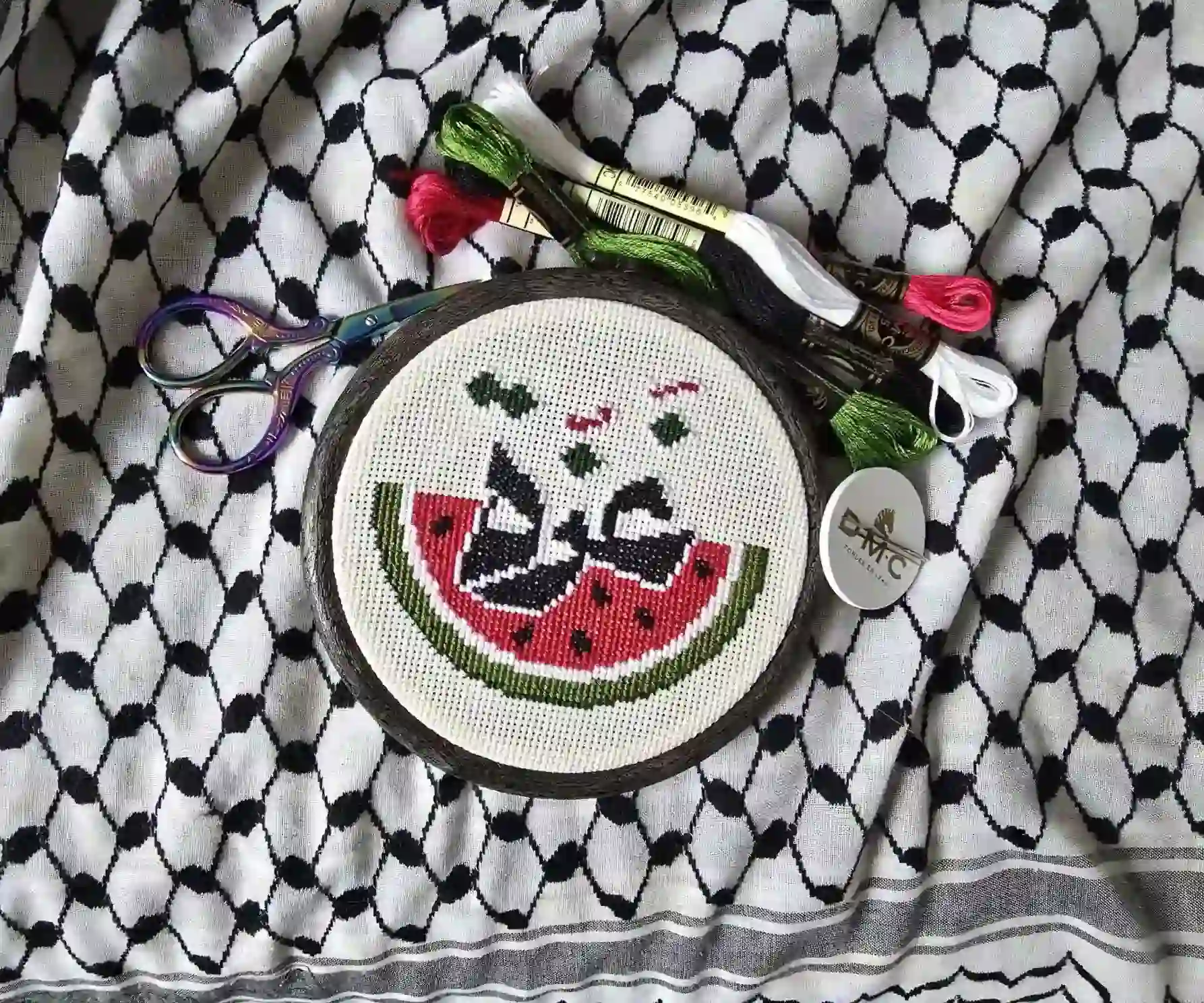
Threads. Cross-stitch typically uses 6-stranded cotton embroidery floss, such as DMC size 25, available in over 500 shades. Each 8 m skein contains 6 strands, and most projects use two strands for stitching, effectively providing 24 m of usable thread per skein. The floss gives excellent coverage and a flat, neat finish on the fabric.
In contrast, Tatreez traditionally uses Perlé cotton, such as DMC size 8, available in fewer shades than 6-stranded floss, just over 200, and sold in 80 m balls. This thicker, non-divisible thread produces bold, textured motifs, giving traditional Palestinian cross-stitch its distinctive, striking look. Its thickness is roughly equivalent to two or three strands of uses 6-stranded cotton.
Technique
Technique. While cross stitch often requires a hoop to keep the fabric taut, Tatreez is typically stitched by hand without a hoop, likely because of the lower-count fabric. Patterns are rarely printed; instead, they are memorized, copied from finished pieces, or passed down visually. When Tatreez is added to thobes (traditional dresses), waste canvas may be used temporarily to guide the stitches. Palestinian women generally do not use charts.
Meaning, Colors, and Motifs
Meaning. Cross stitch designs include samplers, landscapes, portraits, and florals, focusing on full coverage and decorative variety. Tatreez, by contrast, uses geometric motifs, each carrying symbolic meaning: cypress trees for rootedness, stars or moons for guidance, and birds for freedom. Red signifies vitality, while touches of blue, green, or orange reflect local identity.
Motifs are placed strategically, leaving fabric visible to tell the wearer’s story. Tatreez is passed down through families, with regional styles revealing village, social identity, and heritage. For Palestinian tatreez motifs, visit Tirazain , an initiative documenting traditional designs.
Hobby vs Profession?
One of the clearest differences between cross stitch and Tatreez is how they are practiced. Cross stitch is usually a hobby—something people do for relaxation, decoration, or gifting. The practice is primarily recreational. Tatreez, on the other hand, has been a profession. Palestinian women relied on cross stitch for income, creating pieces for their communities or for sale.
Today, Tatreez extends far beyond clothing. Shops across Palestine sell tatreez on mirrors, trays, thobes, wall hangings, clocks—transforming ordinary objects into cultural statements that blend artistry with daily life.
At Gaza Is Kind, we honor this professional tradition while supporting Palestinian women. Our goal is to help women continue Tatreez as a source of income while blending traditional motifs with modern creativity. Our designs combine traditional Tatreez patterns with contemporary cross stitch techniques, creating unique pieces that preserve heritage while appealing to a global audience. Visit our Ko-fi Store and Etsy Store stores to check our designs.
We also offer free Tatreez Patterns (Free Cross Stitch Patterns). Check out the Free Patterns section at our store